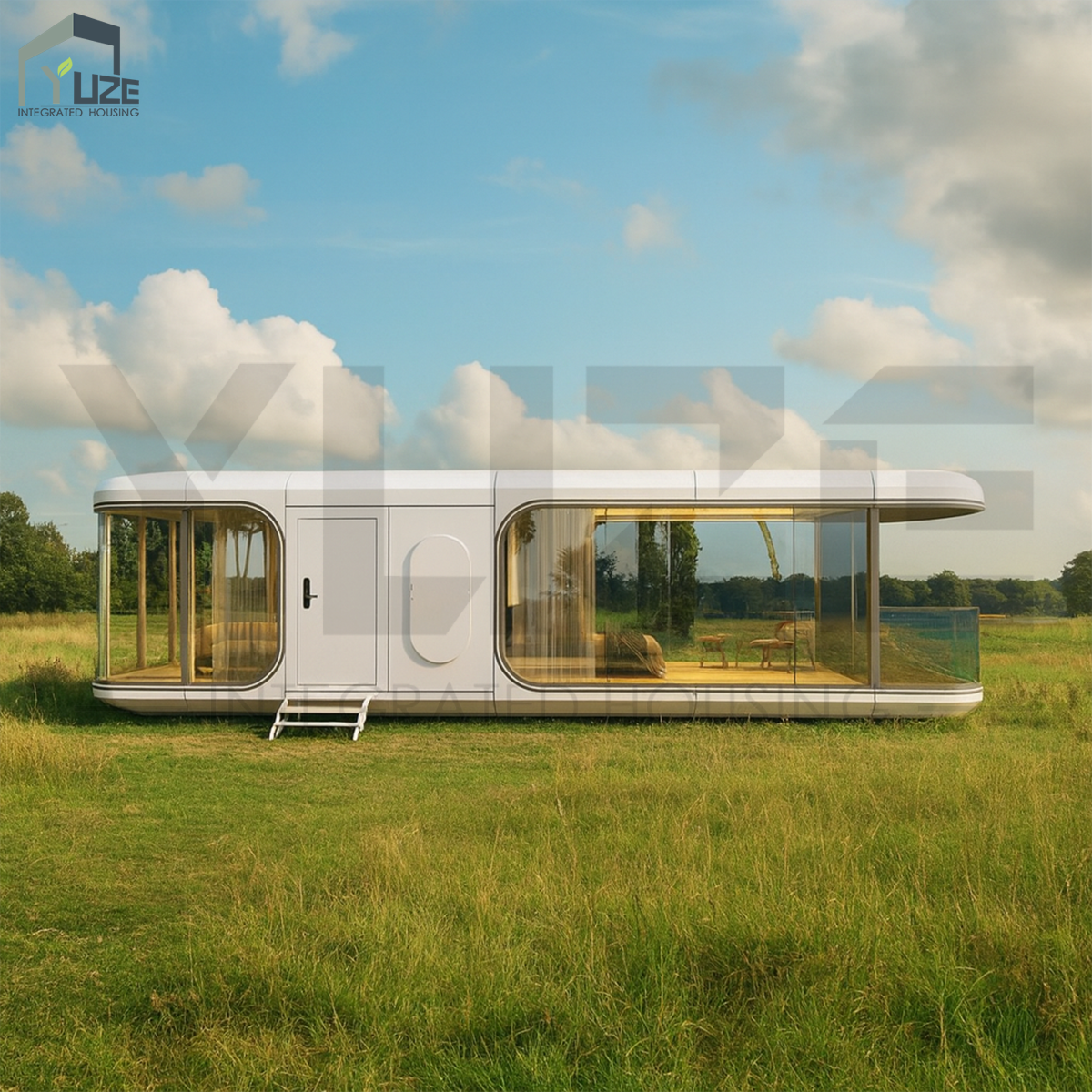
Space capsule houses are changing what our cities look like as they solve some big problems at once: sky-high housing prices, limited land availability, and growing environmental concerns. The market for these compact homes is expected to hit around $4.7 billion by 2030, which means we're seeing these modular units pop up everywhere from Tokyo to New York. What makes them so special? They can be built quickly in crowded neighborhoods where regular construction just doesn't work out. Some developers claim their projects finish in roughly a third of the time needed for conventional buildings. Money matters too. Most city residents shell out between 35 and 50 percent of their paycheck for rent, while capsule living brings that down to about half that amount. Green credentials help push adoption forward as well. Cities with capsule communities often see carbon emissions drop by around 40%, thanks to solar panels on rooftops and walls made from recycled materials originally used in spacecraft manufacturing. As more people move into urban centers every year, these tiny but complete living spaces show us that extreme efficiency doesn't have to come at the cost of comfort or quality of life.
Homes with curved exteriors inspired by airplane design can cut down wind pressure against buildings by around 30 percent when compared to standard rectangular structures. These shapes help buildings withstand harsh storms better and actually make air flow through them more efficiently. Studies on how air moves around buildings show that heating and cooling systems need about 15 to 22 percent less power in these curved designs. Another bonus is that the smooth surfaces work really well for collecting rainwater and mounting solar panels too. Architects find it easier to integrate these green features without messing up the building's overall performance or aesthetics.
Single-shell construction with repurposed aluminum alloys achieves 95% material efficiency while maintaining exceptional strength-to-weight ratios. These frames withstand 150 mph winds and seismic loads exceeding 0.5g acceleration, as validated through finite element analysis. The closed-loop production process reduces embodied carbon by 73% compared to traditional steel framing, meeting LEED v5 certification benchmarks.
Electrochromic polymer composites dynamically adjust transparency and insulation (R-value range: 5–15) based on external conditions. This eliminates the trade-off between natural light access and thermal efficiency—achieving 92% daylight autonomy while maintaining airtight envelopes. Machine learning algorithms optimize membrane configurations hourly, balancing solar heat gain with interior luminosity needs.
Bifacial solar skins turn every exterior surface into an energy-generating asset, capturing sunlight from both sides. This dual-sided photovoltaic technology achieves 30% higher yield than traditional solar arrays, enabling net-zero energy performance in compact designs. The ultra-thin, weather-resistant panels integrate seamlessly with curved exteriors, maintaining durability across diverse climates.
Mycelium insulation made from fungal networks offers an impressive R-8 rating per inch, which actually beats the 2025 IECC standards by around 22%. Plus, it breaks down completely when discarded, so there's no long term waste problem. What makes this stuff really special is how it manages moisture levels naturally through capillary action, stopping condensation issues that often plague modern buildings with tight seals. When manufacturers grow these materials in molds shaped exactly like capsules, they end up with something that works better than regular foam products for keeping heat in or out while being much kinder to the planet overall.
| Feature | Conventional Material | Space Capsule Innovation | Performance Gain |
|---|---|---|---|
| Energy Generation | Monofacial solar | Bifacial skins | +30% yield |
| Insulation Value | Fiberglass (R-4.3/in) | Mycelium composite | +86% R-value |
| Carbon Footprint | Positive emissions | Carbon-negative cycle | 100% reduction |
In space capsule homes, edge AI chips process live biometric info like skin temps, heart rhythm changes, and breathing rates to tweak air flow, moisture levels, and room temps automatically. Each person gets their own personalized climate bubble without needing anyone to touch controls or settings. The edge computing tech behind this works so fast (under 50 ms responses) that there's no need to wait for signals from distant servers in the cloud. What makes these systems really stand out is how they keep people comfortable while also changing the outside insulation layers based on what's happening inside, which helps save power over time.
Voice interfaces powered by directional microphones and beamforming tech are starting to take over from those old fashioned switches and touchscreens we all know. The magic happens through natural language processing which understands what people actually say when they ask things like turning down the lights in a specific corner or boosting air circulation in the bathroom area. Meanwhile ultra wideband sensors keep tabs on where folks are hanging out, so adjustments happen exactly where needed. According to research published by IEEE last year, acoustic models can now tell real speech apart from background noise at around 98 percent accuracy. This means spaces become much easier to manage just by talking normally instead of fumbling with buttons everywhere. Interior designers love this because it frees up wall space while making interactions way simpler for everyone involved.

Guangzhou Yuze Integrated Housing Co., Ltd.
Copyright © Guangzhou Yuze Integrated Housing Co., Ltd. - Privacy policy

 EN
EN