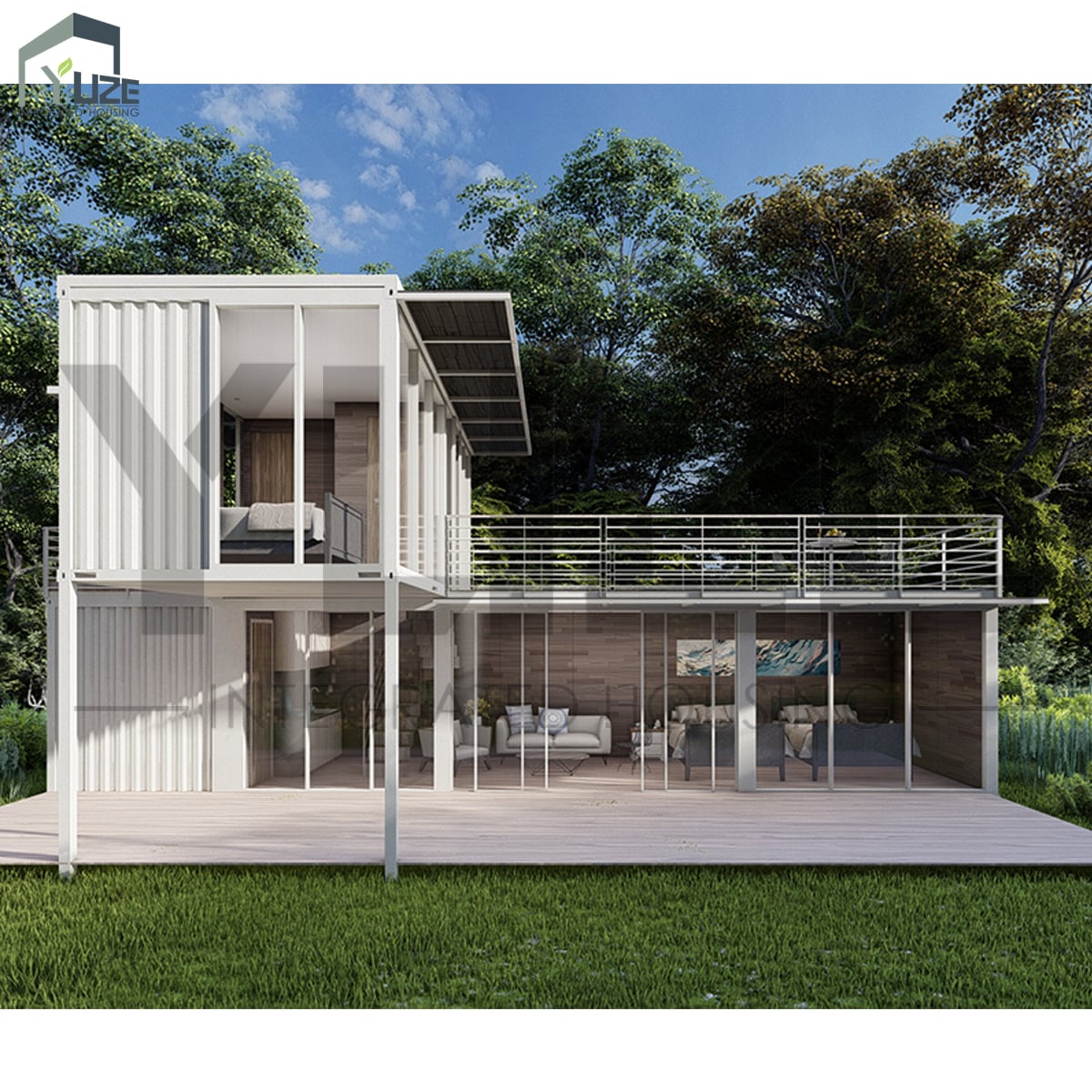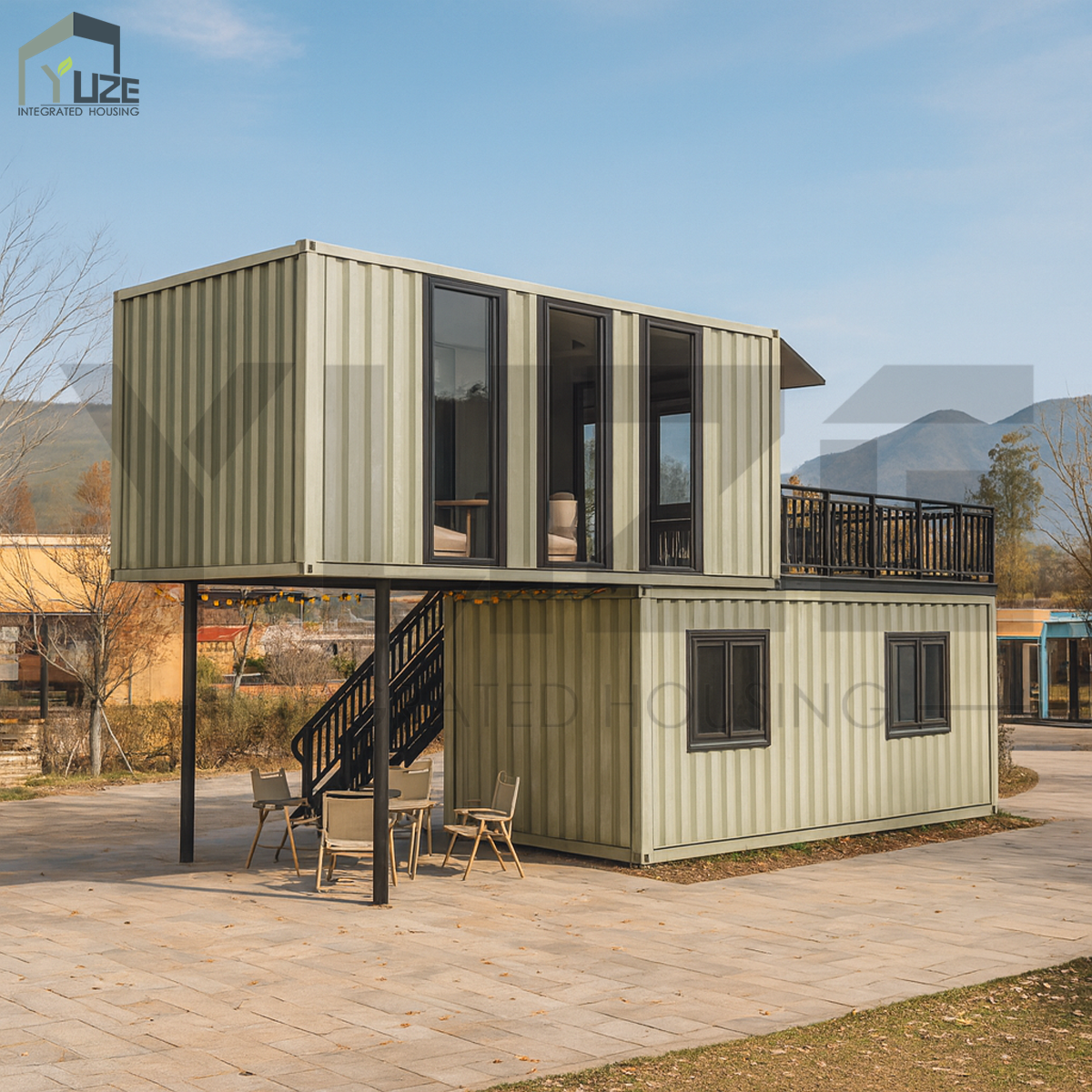
The container itself forms the core of a container house budget. New one-trip containers cost $4,000–$7,000 for a 20-foot unit and $6,000–$10,000 for a 40-foot unit. Used cargo-worthy or wind-and-watertight containers range from $2,000–$5,000 and $3,000–$8,000 respectively. While used options appear cheaper upfront, structural compromises often erase those savings: heavily damaged units may require $3,000–$8,000 in steel replacement, rust remediation, or floor repairs. Building inspectors frequently reject containers with significant corrosion, buckling, or frame deformation—making residential occupancy certification difficult or impossible. New one-trip containers offer a lifespan of 25+ years versus 10–15 years for used units, and their factory-fresh condition simplifies compliance with local structural standards like AS 4100 or the International Building Code (IBC). For long-term reliability and code acceptance, investing in certified one-trip containers is consistently more economical than retrofitting compromised used units.
Delivery and logistics significantly affect total acquisition cost—and often compound unexpectedly. Transporting a single container from supplier to site typically costs $500–$3,000, depending on distance, road access, and crane or tilt-bed requirements. Remote, forested, or steep-slope sites push delivery toward the upper end, especially if temporary road upgrades or ground stabilization are needed. Import duties and customs brokerage fees apply when sourcing containers directly from overseas ports—particularly relevant for buyers purchasing from international suppliers without domestic distribution partners. Regional supply dynamics also influence timing: longer hauls mean extended lead times, which can delay permitting, foundation work, and assembly scheduling. To optimize cost and schedule, prioritize local or regionally based suppliers who stock certified residential-grade containers—and confirm whether delivery quotes include unloading, repositioning, and final leveling.
Proper site preparation establishes the literal groundwork for container house success. Before placing any unit, a professional geotechnical evaluation determines soil bearing capacity, compaction needs, and drainage adequacy. Level sites with favorable natural drainage prevent up to 72% of moisture-related structural issues—including accelerated corrosion—according to 2023 residential construction data. Sloped or high-water-table sites require engineered solutions such as retaining walls, stepped foundations, or elevated piers.
Foundation selection follows three primary paths, each validated by site-specific engineering—especially in seismic, frost-prone, or expansive soil zones:
All foundations must incorporate certified anchoring methods to resist lateral forces acting on container corners. These preparatory steps represent 12–18% of total project budgets yet prevent over 85% of structural complications reported in post-occupancy surveys (Habitat Research Institute, 2023).
Positioning multi-story container houses demands precision crane logistics. Crews lift 10,000+ pound units within tight spatial constraints—often requiring 100-ft boom cranes and certified riggers. Stacking introduces critical alignment challenges: even 5mm deviations at corner posts compromise load path continuity and long-term structural integrity. Standard reinforcement includes:
These modifications add 18–26% to assembly costs but are non-negotiable for safety and durability. Two-story configurations require diaphragm bracing at upper-level interfaces, and all stacked designs mandate foundation tie-downs engineered to withstand uplift and seismic forces.
Permitting timelines vary widely—not because container houses are inherently noncompliant, but because jurisdictions interpret existing codes differently. Coastal municipalities often require wind-load calculations for roof attachments and cladding; urban districts may enforce facade compatibility or setback rules. Approval hinges on three key factors:
Standardized, stamped plans incorporating AS 4100 or Eurocode 3 structural analysis reduce plan review cycles by 35% and minimize revision requests. Crucially, many jurisdictions prohibit cutting or modifying containers prior to approval—so always secure preliminary design review before fabrication begins.
Finishing systems—HVAC, electrical, plumbing, and insulation—typically account for $30–$70 per square foot in container builds due to retrofitting complexity. Uninsulated steel conducts heat 300× faster than wood framing, creating thermal bridges that dramatically increase energy loads and condensation risk.
Steel walls degrade effective R-value by up to 40% without mitigation. Meeting IRC/IECC 2021 minimums (R-13 to R-21, depending on climate zone) requires purpose-built approaches:
| Method | Installed Cost Per Sq Ft | Effective Performance | Space Reduction |
|---|---|---|---|
| Spray Foam | $2.50–$3.80 | Highest air seal (98%) | Minimal |
| SIPs | $5.75–$7.25 | R-14 to R-28 | Up to 5" per wall |
| Mineral Wool | $1.85–$2.90 | R-15 to R-23 | 3–4" per wall |
Without proper thermal bridging mitigation, container walls increase annual energy costs by 27% (RESNET, 2023). Off-ridge MEP routing—running ducts, conduits, and pipes along ceiling or floor planes rather than through wall cavities—maximizes usable interior space within the standard 92-inch width.
Container-specific MEP planning addresses three critical constraints:
Each steel-wall penetration (for outlets, vents, or pipes) costs $500–$800 to reinforce, seal, and insulate properly. Coordinating trades during the “rough-in” phase—rather than sequential retrofits—reduces labor duplication and saves ~$12,000 on average across medium-sized projects.
When evaluating a container house against traditional construction, the shell advantage is real—but nuanced. A basic 40-ft container starts at $3,000–$8,000, whereas framing and sheathing a comparable conventional footprint would cost $25,000–$40,000. On a finished basis, container houses average $100–$120 per square foot, compared to $500–$600 for stick-built homes—driven by pre-engineered walls, reduced material waste, and faster on-site assembly.
Yet final cost depends less on the container itself and more on customization and context. A simple single-container home can be completed for $20,000–$50,000, but adding luxury finishes, multi-story stacking, or advanced energy systems pushes costs to $150–$300 per square foot—narrowing the gap with conventional builds. The most impactful cost drivers are:
Understanding these variables allows buyers to prioritize investments—like certified containers, robust foundations, and thermal envelope integrity—that deliver lasting value, rather than deferring complexity until it compounds cost and risk.
New one-trip containers offer greater structural integrity, longevity, easier compliance with building codes, and a lifespan of over 25 years compared to 10-15 years for used containers.
Delivery costs can vary greatly depending on the distance, site accessibility, and crane requirements. Additional costs may arise for remote or difficult sites.
Site preparation includes soil evaluation, drainage considerations, and selecting the appropriate foundation. This step is crucial for ensuring the long-term stability of the container home.
Permitting timelines can vary due to differing interpretations of building codes by local jurisdictions, varying requirements for wind-load calculations, facade compatibility issues, or specific zoning board policies.
Common insulation strategies include spray foam, SIPs, and mineral wool. These help address the challenge of steel's thermal conductivity and meet energy efficiency codes.

Guangzhou Yuze Integrated Housing Co., Ltd.
Copyright © Guangzhou Yuze Integrated Housing Co., Ltd. - Privacy policy

 EN
EN